Skip to content
Haley A. Catudal’s Father:Parental Alienation Investigation & Exposé Story
I was wronged.The decree protected my place in my daughter’s life. I was denied that relationship, and the enforcement I sought did not restore it.— Haley’s Dad

Open a citation to see what I was supposed to have, what I was denied, and the law connected to those rights.

I did not turn my back on my daughter. This page shows what the decree granted me, what I was denied, and the Ohio, federal, and Army rules connected to those rights.

Ohio Law

What the decree granted me

Page 10 awarded me long-distance parenting time and summer parenting time, except the first and last ten days of summer vacation. Pages 18–19 protected access to covered records, day care, and school activities under the terms stated there.

What I was denied

My October 5, 2012 contempt filing identifies the time and contact I was denied:

The Ohio enforcement provision

R.C. 2705.031(B)(2) permits a parent to seek contempt enforcement when someone fails to comply with or interferes with court-ordered parenting time.

Federal Law

My parenting rights across state lines

The Ohio decree granted me long-distance parenting time. The 2012 filing identifies Anna in Arizona. My daughter living in another state did not, by itself, erase my court-ordered time with her.

The federal protection

28 U.S.C. § 1738A(a), (c)–(h) requires state authorities to recognize and enforce another state’s custody and visitation orders when the statute’s jurisdiction, notice, and other conditions are met.

The contact I was trying to preserve

My winter-break filing and telephone-contact filing identify the parenting time and communication I was denied. Interstate recognition is the federal protection connected to enforcing a qualifying decree across state lines.

UCMJ & Army Duties

The Army duty connected to my decree

AR 608-99 (October 29, 2003), ¶ 2-10(b) required soldiers to comply with applicable court orders concerning custody and visitation. That duty concerned the same parenting time awarded to me on page 10 of the decree.

The contact I was denied

Count 21 of my October 5, 2012 filing identifies denied telephone contact with Haley under the decree and a later order. Count 8 identifies denied winter-break parenting time.

Command duties and military discipline

Paragraph 3-8 requires commanders to investigate custody and visitation inquiries and provide timely, accurate, complete information. Paragraph 3-9(c) leaves ordinary visitation enforcement against a lawful custodian to the courts.

UCMJ Article 92 (10 U.S.C. § 892) addresses qualifying military order or regulation violations and dereliction of duty. It is the military disciplinary framework connected to applicable duties; the parenting time itself comes from the decree.

Back to Section Menu

01 · Court Findings

The decree’s own words

The decree records denied contact and sets out parenting time, access and other protections. These are the passages supporting my position. “Plaintiff” means Haley’s Dad; “Defendant” means Anna C. Catudal.

What the court recorded about denied contact

Court account and recorded allegation

No significant parenting time since October 2010

“Plaintiff has not enjoyed any significant parenting time with Haley since October 2010. Plaintiff relates that he and Defendant agreed that Haley would spend the period of time from January 29, 2011 through February 26, 2011 in his care/custody. In fact, they both purchased airline tickets to this effect. However, in the end, Plaintiff contends that Defendant unilaterally and wrongly refused to honor this prior agreement.”

Decree · page 6

Court assessment

The cancellation explanation was unconvincing

“Defendant unconvincingly claims that she canceled Haley’s visit after the child returned from her October 2010 visit with Plaintiff.”

Decree · page 6

Court assessment

The court called the explanation implausible

“This explanation is implausible to the Court as Defendant admits (and the documents reveal) that she purchased Haley’s airline tickets in November of 2010 and she bases her allegations against Plaintiff upon hearsay “evidence” and relies, at least partly, on the words of a then-4 ½ year old.”

Decree · page 6

Court finding and reasons

Willfully and unreasonably denying access

“Again, the Court takes issue with Defendant’s disingenuous and self-serving explanations for willfully and unreasonably denying Plaintiff access to their daughter given Defendant’s concession that (1) the complained of behavior is a pattern of behavior that Plaintiff has demonstrated throughout the duration of their 6+ year relationship, (2) she chose him as the father of her child, (3) he, not she, filed for the instant divorce, and (4) she was largely aware of Plaintiff’s extensive criminal background before Haley was born and wholly aware of the same by the parties’ date of marriage.”

Decree · page 7

Court assessment of both parents

Roadblock after roadblock

“Frankly, the Court would opine that neither parent is likely to consistently honor and/or facilitate the parenting time rights of the either. Plaintiff is openly livid at Defendant for installing roadblock after roadblock to his parenting time. Meanwhile, Defendant clings to her claims of Plaintiff’s criminality and mental instability like a security blanket. The Court trusts neither parent, and, very sadly, anticipates seeing them frequently for the duration of Haley’s minority.”

Decree · page 9

Court assessment

His history was already known before the marriage

“Again, Plaintiff’s convictions are numerous. Still, all were known to Defendant, and most occurred before the birth of their child. It is notable that Plaintiff’s only relevant offenses (in terms of this particular factor) occurred in 2004 – both before the birth of Haley and date of the parties’ marriage.”

Decree · page 9

My requests and the relationship recorded in the decree

Court assessment

His parenting filing substantially complied

“Plaintiff pro se filed a pseudo Shared Parenting Plan on or about August 29, 2011 in the form of his second Plaintiff’s Amended Complaint for Divorce, which the Court considers substantial compliance with the mandates of ORC §3109.04(G).”

Decree · page 4

Father’s request recorded in decree

He asked for three consecutive months

“Plaintiff indicates that he would like to have parenting time with 5½ year old daughter Haley for 3 consecutive months every year; he wishes the Court to order Long Distance Local Rule 27 to govern for all other provisions, including holidays and breaks.”

Decree · page 4

Mother’s position recorded in decree

Anna also proposed parenting time under the long-distance rule

“Defendant, on the other hand, seeks to be named the legal custodian and residential parent of the minor child with Plaintiff’s parenting time to be governed by Long Distance Local Rule 27. Defendant favors monthly parenting for Plaintiff time but would prefer that he travel to Arizona to exercise the same – given Haley’s age and the flight distance (which, with layovers, easily exceeds 3½ hours).”

Decree · page 4

Guardian ad litem’s report recorded in decree

Haley enjoyed bedtime telephone calls

“The Guardian, however, did interview the child at the home of Defendant in Arizona – he indicates that Haley enjoys speaking with Plaintiff via telephone at bedtime. However, the child appears to be extremely frustrated with the parties’ fighting (and cussing at times) and discord.”

Decree · page 5

GAL recommendation

The GAL recommended parenting time

“Plaintiff should be allocated parenting time in compliance with Local Rule 27,”

Decree · page 5

This is a GAL recommendation. The same page also recommends assessments and progress in civil communication before an increased allocation. The court’s actual parenting order is quoted below.

Father’s allegation recorded in decree

His account of why the visit was canceled

“For his part, he alleges that Defendant unilaterally cancelled Haley’s January 29, 2011 visit because he alerted her to the fact that he was no longer in agreement with their “deal” for him to file for divorce fraudulently denying the existence of their minor child. In short, he claims that because he reneged, she reneged.”

Decree · page 7

Father’s allegation recorded in decree

His allegation of alienation was recorded

“Likewise, Plaintiff questions Defendant’s fitness and/or moral compass for wrongfully alienating him from his daughter for the past year.”

Decree · page 8

The parenting time and access the decree ordered

Court order

The parenting time the court ordered

“Although both parents present certain concerns for the Court, it believes that Defendant is the best choice, at this time, to serve the best interest of the parties’ minor child as legal custodian and residential parent. Plaintiff shall exercise parenting time pursuant to the Court’s model parenting time schedule (Local Rule 27) for parents traveling over 90 miles one way – except that over the course of the summer, Defendant shall have Haley for the first 10 days after school concludes and the 10 days prior to school commencing. Plaintiff shall enjoy parenting time for the remainder of the summer break.”

Decree · page 10

Required notice

Notice of relocation and a possible parenting-time hearing

“IF THE RESIDENTIAL PARENT INTENDS TO MOVE TO A RESIDENCE OTHER THAN THE RESIDENCE SPECIFIED IN THE PARENTING TIME ORDER OR DECREE OF THE COURT, THE RESIDENTIAL PARENT SHALL FILE A NOTICE OF INTENT TO RELOCATE WITH THIS COURT, ADDRESSED TO THE ATTENTION OF THE RELOCATION OFFICER. UNLESS OTHERWISE ORDERED PURSUANT TO O.R.C. SECTIONS 3109.051(G)(2), (3), AND (4), A COPY OF SUCH NOTICE SHALL BE MAILED BY THE COURT TO THE PARENT WHO IS NOT THE RESIDENTIAL PARENT. UPON RECEIPT OF THE NOTICE, THE COURT, ON ITS OWN MOTION OR THE MOTION OF EITHER PARTY, MAY SCHEDULE A HEARING WITH NOTICE TO BOTH PARTIES TO DETERMINE WHETHER IT IS IN THE BEST INTEREST OF THE CHILD TO REVISE THE PARENTING TIME SCHEDULE.”

Decree · page 18

Required records-access notice

Access to Haley’s records on the same terms

“EXCEPTING AS SPECIFICALLY MODIFIED OR OTHERWISE LIMITED BY COURT ORDER, AND SUBJECT TO O.R.C. SECTIONS 3125.16 AND 3319.321(F), THE PARENT WHO IS NOT THE RESIDENTIAL PARENT, IS ENTITLED TO ACCESS TO ANY RECORD THAT IS RELATED TO THE CHILD, UNDER THE SAME TERMS AND CONDITIONS AS THE RESIDENTIAL PARENT, AND TO WHICH SAID RESIDENTIAL PARENT IS LEGALLY PROVIDED ACCESS. ANY KEEPER OF A RECORD WHO KNOWINGLY FAILS TO COMPLY WITH THIS ORDER IS IN CONTEMPT OF COURT.”

Decree · page 18

Required day-care access notice

Access to Haley’s day-care center

“EXCEPTING AS SPECIFICALLY MODIFIED OR OTHERWISE LIMITED BY COURT ORDER, AND IN ACCORDANCE WITH O.R.C. SECTION 5104.011, THE PARENT WHO IS NOT THE RESIDENTIAL PARENT, IS ENTITLED TO ACCESS TO ANY DAY CARE CENTER THAT IS OR WILL BE ATTENDED BY THE CHILD WITH WHOM PARENTING TIME IS GRANTED, TO THE SAME EXTENT THAT THE RESIDENTIAL PARENT, IS GRANTED ACCESS TO THE CENTER.”

Decree · page 18

Required school-activities notice

Access to Haley’s school activities on the same terms

“EXCEPTING AS SPECIFICALLY MODIFIED OR OTHERWISE LIMITED BY COURT ORDER, AND SUBJECT TO O.R.C. SECTION 3319.321(F), THE PARENT WHO IS NOT THE RESIDENTIAL PARENT, IS ENTITLED TO ACCESS, UNDER THE SAME TERMS AND CONDITIONS AS THE RESIDENTIAL PARENT, TO ANY STUDENT ACTIVITY THAT IS RELATED TO THE CHILD AND TO WHICH THE RESIDENTIAL PARENT OF THE CHILD LEGALLY IS PROVIDED ACCESS. ANY SCHOOL EMPLOYEE OR OFFICIAL WHO KNOWINGLY FAILS TO COMPLY WITH THIS ORDER IS IN CONTEMPT OF COURT.”

Decree · page 19

Travel costs, support, health care and taxes

GAL recommendation

The GAL recommended a travel-cost adjustment

“Plaintiff should be granted a minor deviation from the guideline child support obligation based upon his final allocation of parenting time to account for the costs of transporting the child.”

Decree · page 5

Court assessment

The court agreed a support deviation was warranted

“The resulting guideline child support figure is $299.22 per month, plus $5.98 processing charge for a total monthly amount of $305.20 per month. Plaintiff rightly argues, and the Guardian ad Litem agrees, that he should be awarded a deviation from this guideline figure pursuant to ORC §3119.23.”

Decree · page 10

Father’s explanation and court agreement on driving

The court recognized long-distance travel costs

“Plaintiff argues that factor (d) “extended parenting time or extraordinary costs associated with parenting time” is applicable as each airline trip for Haley from Arizona to Columbus costs him roughly $2,000 because, as Plaintiff explains it, (1) he is never able to book very far in advance (due to funds shortages) and (2) he travels to Arizona and flies back to Columbus, Ohio with the child. He further explains that driving that type of distance with a 5½ year old child is impractical – this Court agrees.”

Decree · page 11

Court statement

No child-support arrears in this case at that time

“As the parties contrived to mutually deny the existence of their daughter pursuant to their underhanded side agreement, child support was never established for the benefit of young Haley. Therefore, there are no child support delinquencies or arrearages in this case.”

Decree · page 9

Court finding and order

The child-support reduction the court granted

“After considering the factors and criteria set forth in section ORC §3119.23, the Court hereby finds that the amount calculated pursuant to the basic child support schedule and the applicable worksheet, to wit: $299.22 per month, plus $5.98 processing charge for a total monthly amount of $305.20 per month, would be unjust or inappropriate and would not be in the best interest of the child. See Attachment B, Child Support Computation Summary Worksheet. Accordingly, the Court grants Plaintiff a downward deviation to $98.01 per month, plus processing charge based upon its consideration of statutory factors (d), (l) and (p).”

Decree · page 14

Decree provision

Anna’s health-insurance responsibility and share of medical expenses

“The parties agree that Defendant shall maintain health insurance coverage for the child. Pursuant to ORC §3119.01, the parties shall equally pay the first $100 of the reasonable and ordinary uninsured and unreimbursed medical expenses for the minor child. Any extraordinary medical expenses (defined as those exceeding the first $100) including co-payments and/or deductibles shall be divided between the parties with Plaintiff paying 37% of such expenses and Defendant paying the remaining 63% of the same.”

Decree · page 15

Court order

The continuing health-insurance order

“Effective as of the date of the child support order, Defendant is designated as the health insurance obligor and shall provide private health insurance for the benefit of the minor child for so long as the duty to support exists or until further order of the court.”

Decree · page 19

Court order — insured periods

The medical-expense split while insurance is in effect

“Mother shall pay 63% and Father shall pay 37% of all extraordinary medical and other health care expenses for the children, which are defined as uncovered medical and other health care expenses exceeding $100 per child per calendar year.”

Decree · page 19

Court order — uninsured periods

The medical-expense split while insurance is not in effect

“Mother shall pay 63% and Father shall pay 37% of all extraordinary medical and other health care expenses for the child, which are defined as all medical and other health care expenses exceeding the amount paid by the obligor for cash medical support per calendar year.”

Decree · page 20

Court order

When cash medical support starts and stops

“If the obligor is ordered to pay cash medical support under this support order, the obligor shall begin payment of any cash medical support on the first day of the month immediately following the month in which private health insurance coverage is unavailable or terminates and shall cease payment on the last day of the month immediately preceding the month in which private health insurance coverage begins or resumes. During the period when cash medical support is required to be paid, the obligor or obligee must immediately inform the child support enforcement agency that health insurance coverage for the children has become available.”

Decree · page 20

Court order

Notice and an opportunity to be heard about an insurance mistake

“The child support enforcement agency shall give the obligor notice in accordance with Chapter 3121. of the Revised Code and provide the obligor an opportunity to be heard if the obligor believes there is a mistake of fact regarding the availability of private health insurance at a reasonable cost as determined under division (B) of this section.”

Decree · page 20

Required notice

Notice when there is a reason support should terminate

“The residential parent or the person who otherwise has custody of a child for whom a support order is issued is also ordered to immediately notify, and the obligor under a support order may notify, the Franklin County Child Support Enforcement Agency of any reason for which the support order should terminate, including but not limited to, the child's attainment of the age of majority if the child no longer attends an accredited high school on a full-time basis and the child support order requires support to continue past the age of majority only if the child continuously attends such a high school after attaining that age; the child ceasing to attend an accredited high school on a full-time basis after attaining the age of majority, if the child support order requires support to continue past the age of majority only if the child continuously attends such a high school after attaining that age; or the death, marriage, emancipation, enlistment in the armed services, deportation, or change of legal custody of the child.”

Decree · page 17

Decree provision

The odd-year tax claim and its stated condition

“Given the Court's grant of a deviation, Defendant shall claim the minor child in all even-numbered years, and Plaintiff shall claim the minor child in all odd-numbered years. Plaintiff's failure to remain substantially current in his child support obligation shall constitute a forfeiture of his right to claim Haley as a deduction for income tax purposes.”

Decree · page 15

Property protections and carrying out the decree

Court order

His own vehicle free of the other party’s claim

“The parties agree and the Court further ORDERS that each party shall hold his/her vehicle free and clear from any claim of the other.”

Decree · page 3

Court order

Protection from vehicle debt and a transfer deadline

“Finally, the retaining party is hereby ORDERED to hold the other harmless from any obligation or liability related to his/her awarded assets, and Defendant must make all reasonable efforts to transfer said vehicle (i.e., the 2009 Dodge Caliber) into her individual name as soon as practicable. In the event she is unable to qualify for a refinance of said vehicle on/before December 31, 2011, she shall immediately list the vehicle for sale. In the event the vehicle is repossessed due to non-payment, Defendant shall be liable for any resultant deficiency and shall hold Plaintiff harmless on the same.”

Decree · page 3

Court order

Personal property free of the other party’s claim

“Each party shall retain those items of personalty that are currently in their respective possessions, except as noted below. Each party shall hold those items free and clear from any claims of the other.”

Decree · page 3

Court order

Accounts free of the other party’s claim

“Both parties agree that they share no joint and/or marital bank accounts; nor do they hold accounts bearing both parties’ names. Neither party has a marital interest in a retirement account. Therefore, the Court hereby ORDERS that each party shall retain the accounts in his or her current possession, free and clear of any claim of the other.”

Decree · page 4

Court order

Each party’s attorney fees and the court-cost exception

“In this case, neither party has requested a court-ordered contribution to his/her attorney’s fees and litigation expenses. Therefore, after thoroughly weighing all the statutory factors and the totality of circumstances in this case, the Court finds that it is equitable for Plaintiff and Defendant to each pay and hold each other harmless for his/her own attorney/court fees associated with this litigation. Any outstanding court costs shall be paid by Plaintiff.”

Decree · page 21

Court order

Both parties had to carry the decree into effect

“The parties shall execute all documents, writings and instruments and do all other things necessary to carry this Decree into full force and effect. In the event such documents are not duly executed, the Court authorizes any public official to accept a certified copy of this Decree in lieu of the actual document necessary or required to carry this Decree into full force and effect.”

Decree · page 21

Instruction to the clerk

Notice of the judgment and its entry date

“Pursuant to Civil Rule 58(B), you are hereby instructed to serve upon all parties not in default for failure to appear, notice of the judgment and its date of entry upon the journal”

Decree · page 22

Excerpts from the original 22-page decree. Page links open the complete PDF at the cited page. The long-distance schedule is incorporated on page 10; its referenced Attachment A is not included in this scan.

02 · Original Decree

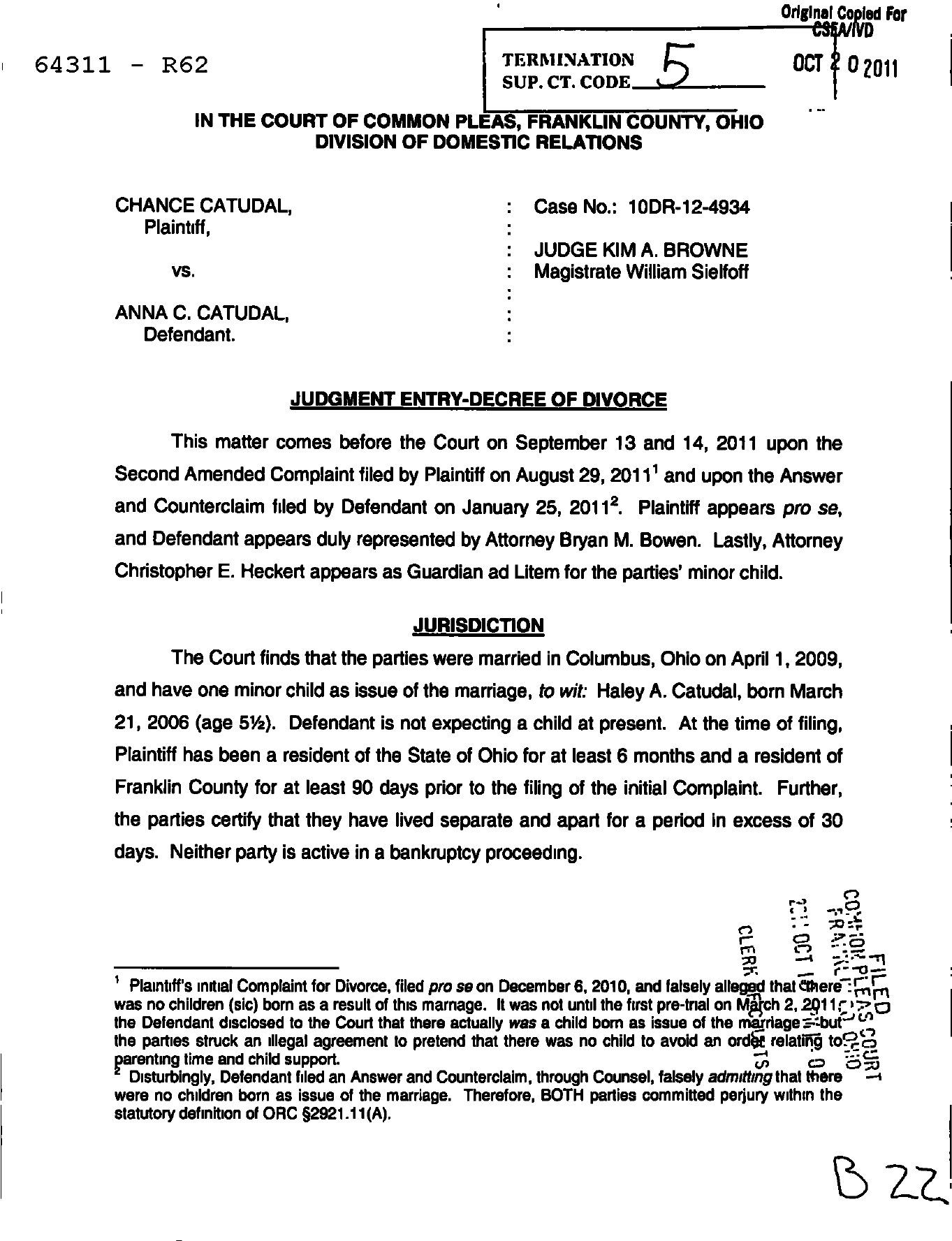
The original 22-page decree

The PDF below is the original uploaded 22-page scan, unchanged. The viewer shows those same pages. The referenced attachments are not present in this file.

Court
Franklin County Court of Common Pleas
Division of Domestic Relations, Ohio
Case referenced
10DR-12-4934
Haley’s Dad and Anna C. Catudal
Record supplied
22 pages · Judge Kim A. Browne
Clerk’s filed stamp: October 19, 2011

The website’s shorter case label is preserved. The decree uses the fuller case number above. Its first-page copy stamp is October 20, 2011; its clerk’s filed stamp reads October 19, 2011.

Use the left and right arrows to turn pages. Keyboard arrows work when the reader is focused.

Page 1 of 22 · Case caption and jurisdiction

Decree of divorce, page 1 of 22: case caption and jurisdiction

Tap or click the page to open it at full size. On a phone, pinch to zoom in that new tab.

Download the Divorce Decree (PDF)

03 · Rights & Provisions

The rights and duties in the decree

The table covers the provisions identified in the supplied decree and its incorporated long-distance model rule, including conditions and reciprocal duties. “No separate federal entitlement” means the relevant right comes from Ohio law and the court order; a federal statute is not needed for every row.

47 provisions

Each provision, its decree location, and the laws or Army rules that relate to it
Right / provisionWhat it provided and where to find itOhio / state authorityFederal authorityArmy connection
01Parenting time as Haley’s fatherExpress decreeThe court designated Anna as residential parent and legal custodian, and ordered parenting time for Haley’s Dad under the long-distance schedule. It did not terminate his parental rights or award shared legal custody.

Decree p. 10

R.C. 3109.04(A)(1); R.C. 3109.051(A), (D), (F)(2)28 U.S.C. § 1738A (PKPA): recognition in another state if the statute’s conditions are met; it does not set this schedule.AR 608-99 ¶¶ 2-10(b), 3-9: compliance duty; see the limits on command enforcement.
02Most of the summer school breakExpress decreeAnna received the first 10 days after school ended and the 10 days before school began. Haley’s Dad received the remainder of the summer break. This express provision overrides the model rule’s usual half-summer division. The school calendar is needed to calculate actual dates.

Decree p. 10

R.C. 3109.051(A), (D), (F)(2); Rule 27: specific decree terms take precedence28 U.S.C. § 1738A (PKPA): recognition in another state if the statute’s conditions are met; it does not set this schedule.AR 608-99 ¶¶ 2-10(b), 3-9: compliance duty; see the limits on command enforcement.
03An agreed schedule, with a minimum when parents could not agreeIncorporated rule · attachment check pendingThe long-distance rule permits agreed times and places, with its listed minimum schedule. Its school-calendar framework also applies to preschool-age children unless otherwise agreed. Without an agreement, the ordered minimum still applied.

Decree p. 10; former Rule 27: opening provisions and “Pre-School Age”

R.C. 3109.051(A), (D), (F)(2); former Rule 27, over-90-mile schedule28 U.S.C. § 1738A (PKPA): recognition in another state if the statute’s conditions are met; it does not set this schedule.AR 608-99 ¶¶ 2-10(b), 3-9: compliance duty; see the limits on command enforcement.
04Half of winter break, alternating halves annuallyIncorporated rule · attachment check pendingWinter break is divided into two halves, with the parents alternating which half they receive each year. The long-distance text does not assign the initial half to a particular parent; that requires the actual attachment or an agreement/order.

Decree p. 10; former Rule 27: “Winter Break”

R.C. 3109.051(A), (D), (F)(2); former Rule 27, over-90-mile schedule28 U.S.C. § 1738A (PKPA): recognition in another state if the statute’s conditions are met; it does not set this schedule.AR 608-99 ¶¶ 2-10(b), 3-9: compliance duty; see the limits on command enforcement.
05The whole spring break in odd-numbered yearsIncorporated rule · attachment check pendingThe nonresidential parent receives the entire school vacation in odd-numbered years, from the day school ends to the day before it resumes. This is the long-distance rule, not the different nearby-parent holiday schedule.

Decree p. 10; former Rule 27: “Spring Break”

R.C. 3109.051(A), (D), (F)(2); former Rule 27, over-90-mile schedule28 U.S.C. § 1738A (PKPA): recognition in another state if the statute’s conditions are met; it does not set this schedule.AR 608-99 ¶¶ 2-10(b), 3-9: compliance duty; see the limits on command enforcement.
06Summer dates in time to planIncorporated rule · attachment check pendingThe residential parent supplies the beginning and ending dates of summer vacation by March 15; the nonresidential parent gives notice of intentions by April 15. Necessary summer school must be attended. The decree’s expanded summer allocation controls over the rule’s half-summer default.

Decree p. 10; former Rule 27: “Summer”

R.C. 3109.051(A), (D), (F)(2); former Rule 27, over-90-mile schedule28 U.S.C. § 1738A (PKPA): recognition in another state if the statute’s conditions are met; it does not set this schedule.AR 608-99 ¶¶ 2-10(b), 3-9: compliance duty; see the limits on command enforcement.
07An uninterrupted vacation of up to two weeksIncorporated rule · attachment check pendingEither parent may arrange an uninterrupted vacation of no more than two weeks. This is subject to the decree’s allocation of parenting time; it does not automatically add two extra weeks beyond it.

Decree p. 10; former Rule 27: “Vacations”

R.C. 3109.051(A), (D), (F)(2); former Rule 27, over-90-mile schedule28 U.S.C. § 1738A (PKPA): recognition in another state if the statute’s conditions are met; it does not set this schedule.AR 608-99 ¶¶ 2-10(b), 3-9: compliance duty; see the limits on command enforcement.
08Travel information while Haley was awayIncorporated rule · attachment check pendingThe rule calls for a general itinerary if more than two days of the summer period are spent away from a parent’s home, and for dates, locations, addresses and telephone numbers for a vacation trip away from home. These are reciprocal duties.

Decree p. 10; former Rule 27: “Summer” and “Vacations”

R.C. 3109.051(A), (D), (F)(2); former Rule 27, over-90-mile schedule28 U.S.C. § 1738A (PKPA): recognition in another state if the statute’s conditions are met; it does not set this schedule.AR 608-99 ¶¶ 2-10(b), 3-9: compliance duty; see the limits on command enforcement.
09A monthly weekend at his home, subject to the travel limitIncorporated rule · attachment check pendingA monthly weekend is permitted if the child’s one-way traveling time does not exceed 3½ hours. At least one week’s notice and transportation by the nonresidential parent are required. The decree discusses longer Arizona–Ohio travel on page 4, so this was a conditional provision, not an unconditional monthly flight entitlement.

Decree p. 10; former Rule 27: “Additional Parenting time — Weekend”

R.C. 3109.051(A), (D), (F)(2); former Rule 27, over-90-mile schedule28 U.S.C. § 1738A (PKPA): recognition in another state if the statute’s conditions are met; it does not set this schedule.AR 608-99 ¶¶ 2-10(b), 3-9: compliance duty; see the limits on command enforcement.
10Father’s Day with her fatherIncorporated rule · attachment check pendingThe long-distance rule says Father’s Day and Mother’s Day should always be spent with the appropriate parent. It does not print the nearby-parent schedule’s separate birthday and hourly details.

Decree p. 10; former Rule 27: “Additional Parenting time”

R.C. 3109.051(A), (D), (F)(2); former Rule 27, over-90-mile schedule28 U.S.C. § 1738A (PKPA): recognition in another state if the statute’s conditions are met; it does not set this schedule.AR 608-99 ¶¶ 2-10(b), 3-9: compliance duty; see the limits on command enforcement.
11Parenting time when Haley’s Dad visited Haley’s areaIncorporated rule · attachment check pendingHaley’s Dad gives at least two days’ advance notice that he will be in the area and wants parenting time. The rule says that parenting time shall occur absent extraordinary circumstances.

Decree p. 10; former Rule 27: “Additional Parenting time”

R.C. 3109.051(A), (D), (F)(2); former Rule 27, over-90-mile schedule28 U.S.C. § 1738A (PKPA): recognition in another state if the statute’s conditions are met; it does not set this schedule.AR 608-99 ¶¶ 2-10(b), 3-9: compliance duty; see the limits on command enforcement.
12Parenting time when Anna and Haley visited Haley’s Dad’s areaIncorporated rule · attachment check pendingThe residential parent gives at least two days’ notice when she and the child will be in the nonresidential parent’s area, and the rule says parenting time must be allowed.

Decree p. 10; former Rule 27: “Additional Parenting time”

R.C. 3109.051(A), (D), (F)(2); former Rule 27, over-90-mile schedule28 U.S.C. § 1738A (PKPA): recognition in another state if the statute’s conditions are met; it does not set this schedule.AR 608-99 ¶¶ 2-10(b), 3-9: compliance duty; see the limits on command enforcement.
13At least three telephone calls each weekIncorporated rule · attachment check pendingThe parent without the child is entitled to telephone communication at least three times weekly, for at least 15 minutes per call. The provision works both ways during each parent’s time.

Decree p. 10; former Rule 27: “Telephone Access”

R.C. 3109.051(A), (D), (F)(2); former Rule 27, over-90-mile schedule28 U.S.C. § 1738A (PKPA): recognition in another state if the statute’s conditions are met; it does not set this schedule.AR 608-99 ¶¶ 2-10(b), 3-9: compliance duty; see the limits on command enforcement.
14Haley could call either parentIncorporated rule · attachment check pendingThe child may call either parent as often as she wishes at reasonable times. The historical rule specifies collect calling for long-distance calls.

Decree p. 10; former Rule 27: “Telephone Access”

R.C. 3109.051(A), (D), (F)(2); former Rule 27, over-90-mile schedule28 U.S.C. § 1738A (PKPA): recognition in another state if the statute’s conditions are met; it does not set this schedule.AR 608-99 ¶¶ 2-10(b), 3-9: compliance duty; see the limits on command enforcement.
15Telephone contact without interferenceIncorporated rule · attachment check pendingThe parent with the child must not interfere with or stop telephone communication. This protects the contact described in the two preceding rows.

Decree p. 10; former Rule 27: “Telephone Access”

R.C. 3109.051(A), (D), (F)(2); former Rule 27, over-90-mile schedule28 U.S.C. § 1738A (PKPA): recognition in another state if the statute’s conditions are met; it does not set this schedule.AR 608-99 ¶¶ 2-10(b), 3-9: compliance duty; see the limits on command enforcement.
16Advance planning for transportationIncorporated rule · attachment check pendingTransportation costs and pickup/drop-off arrangements are to be decided in advance and written into a court order. The decree granted a support deviation partly because of parenting-time travel costs. The supplied pages do not independently order Anna to pay half of airfare; the nearby-parent rule’s equal-transportation clause must not be imported here.

Decree p. 10; former Rule 27: “Transportation”; see decree pp. 11 and 14

R.C. 3109.051(A), (D), (F)(2); former Rule 27, over-90-mile schedule28 U.S.C. § 1738A (PKPA): recognition in another state if the statute’s conditions are met; it does not set this schedule.AR 608-99 ¶¶ 2-10(b), 3-9: compliance duty; see the limits on command enforcement.
17Notice of a move and good-faith schedule discussionsIncorporated rule · attachment check pendingThe long-distance rule requires immediate notice on learning/determining a move, with the date, new address, telephone number and information needed for the child’s transition, plus good-faith efforts to renegotiate an appropriate schedule. Read this with the decree’s express statutory relocation exceptions on page 18.

Decree p. 10; former Rule 27: “Moving”

R.C. 3109.051(A), (D), (F)(2); former Rule 27, over-90-mile schedule28 U.S.C. § 1738A (PKPA): recognition in another state if the statute’s conditions are met; it does not set this schedule.AR 608-99 ¶¶ 2-10(b), 3-9: compliance duty; see the limits on command enforcement.
18A current address and telephone numberIncorporated rule · attachment check pendingEach parent keeps the other informed of current contact details at all times, except as provided by the court order. This historical provision is not permission to publicly disclose anyone’s address.

Decree p. 10; former Rule 27: “Current Address and Telephone Number”

R.C. 3109.051(A), (D), (F)(2); former Rule 27, over-90-mile schedule28 U.S.C. § 1738A (PKPA): recognition in another state if the statute’s conditions are met; it does not set this schedule.AR 608-99 ¶¶ 2-10(b), 3-9: compliance duty; see the limits on command enforcement.
19An emergency contact numberIncorporated rule · attachment check pendingBoth parents provide the other with a telephone number for emergencies, whether or not the child is currently with that parent.

Decree p. 10; former Rule 27: “Emergency Contact”

R.C. 3109.051(A), (D), (F)(2); former Rule 27, over-90-mile schedule28 U.S.C. § 1738A (PKPA): recognition in another state if the statute’s conditions are met; it does not set this schedule.AR 608-99 ¶¶ 2-10(b), 3-9: compliance duty; see the limits on command enforcement.
20The required car seat at exchangesIncorporated rule · attachment check pendingWhen the law requires a car seat, the parents transfer it with the child during parenting-time exchanges.

Decree p. 10; former Rule 27: “Car Seat”

R.C. 3109.051(A), (D), (F)(2); former Rule 27, over-90-mile schedule28 U.S.C. § 1738A (PKPA): recognition in another state if the statute’s conditions are met; it does not set this schedule.AR 608-99 ¶¶ 2-10(b), 3-9: compliance duty; see the limits on command enforcement.
21Cooperation exchanging Haley’s clothingIncorporated rule · attachment check pendingThe parents cooperate in exchanging the child’s clothing before and after parenting time.

Decree p. 10; former Rule 27: “Clothing”

R.C. 3109.051(A), (D), (F)(2); former Rule 27, over-90-mile schedule28 U.S.C. § 1738A (PKPA): recognition in another state if the statute’s conditions are met; it does not set this schedule.AR 608-99 ¶¶ 2-10(b), 3-9: compliance duty; see the limits on command enforcement.
22Notice filed with the court before relocationExpress decreeThe residential parent must file a notice of intent to relocate with the court’s relocation officer. The court mails Haley’s Dad a copy unless otherwise ordered under the statutory exceptions. This is not an unconditional veto over relocation.

Decree p. 18

R.C. 3109.051(G)(1)–(4)28 U.S.C. § 1738A (PKPA): recognition in another state if the statute’s conditions are met; it does not set this schedule.AR 608-99 ¶¶ 2-10(b), 3-9: compliance duty; see the limits on command enforcement.
23The ability to request a relocation hearingExpress decreeOn receipt of the relocation notice, either party may seek a hearing on whether the parenting schedule should be revised in Haley’s best interest. The decree says the court may schedule that hearing; it does not promise a particular result.

Decree p. 18

R.C. 3109.051(G)(1)28 U.S.C. § 1738A (PKPA): recognition in another state if the statute’s conditions are met; it does not set this schedule.AR 608-99 ¶¶ 2-10(b), 3-9: compliance duty; see the limits on command enforcement.
24Equal access to Haley’s recordsExpress decreeSubject to specific court limitations and the statutory exceptions, Haley’s Dad has access to records related to Haley on the same terms as Anna has lawful access. This includes school records; it is not a grant of joint decision-making custody.

Decree p. 18

R.C. 3109.051(H); R.C. 3319.321(B)(5)(a), (F) and 3125.16, expressly cited in the decree.FERPA: 20 U.S.C. § 1232g; 34 C.F.R. §§ 99.4, 99.10: at covered schools, either parent generally has education-record rights absent a legally effective revocation; inspection is generally due within 45 days.AR 608-99 ¶¶ 2-10(b), 3-9: compliance duty; see the limits on command enforcement.
25Access to medical and other child-related recordsExpress decreeThe same records clause reaches child-related records to which the residential parent is legally entitled. Applicable confidentiality rules, court restrictions and protected categories still matter. Access to records is different from authority to make every medical decision.

Decree p. 18

R.C. 3109.051(H), definition of “Record” in the 2011 statuteHIPAA, 45 C.F.R. § 164.502(g): applicable state law and the scope of parental authority govern, with exceptions for confidential treatment, abuse, neglect or endangerment.AR 608-99 ¶¶ 2-10(b), 3-9: compliance duty; see the limits on command enforcement.
26Equal access to Haley’s day-care centerExpress decreeExcept as limited by court order, Haley’s Dad is entitled to the same extent of access as the residential parent to a day-care center Haley attends or will attend. This access clause does not independently grant a right to remove her outside his parenting time.

Decree p. 18

R.C. 3109.051(I); former R.C. 5104.011, cited in the decree.No separate federal entitlement identified for this provision; the decree and Ohio law supply it.AR 608-99 ¶¶ 2-10(b), 3-9: compliance duty; see the limits on command enforcement.
27Equal access to school activitiesExpress decreeExcept as modified by court order and subject to the cited statutory exception, Haley’s Dad may access student activities related to Haley on the same terms as Anna. A school employee or official who knowingly fails to comply is subject to contempt under the decree.

Decree p. 19

R.C. 3109.051(J); R.C. 3319.321(F), cited in the decree.FERPA addresses education records; it is not the source of this separate school-activity attendance right.AR 608-99 ¶¶ 2-10(b), 3-9: compliance duty; see the limits on command enforcement.
28A reduced child-support amountExpress decreeThe court reduced the guideline amount of $299.22 to $98.01 monthly, plus processing charges. It relied on the historical factors (D), (L) and (P), including extended parenting time/travel costs. The full support worksheet is missing from this upload. This reduction was not permission to withhold support if contact was denied.

Decree p. 14; Decree p. 19

R.C. 3119.22 (2001 version); R.C. 3119.23(D), (L), (P) (2011 text)No separate federal entitlement identified for this provision; the decree and Ohio law supply it.AR 608-99 ¶¶ 1-5(b)(4), 3-9(a): general court-order compliance. This does not create a separate payment or damages award.
29Anna was responsible for maintaining health insuranceExpress decreeAnna is designated the health-insurance obligor and must provide coverage for Haley while the support duty exists or until a further order. The benefit is for Haley, with the costs allocated between her parents.

Decree p. 15; Decree p. 19

Former R.C. 3119.30(A)–(B)This decree does not grant Haley’s Dad his own military health coverage. It assigns responsibility for Haley’s coverage.AR 608-99 ¶¶ 1-5(b)(4), 3-9(a): general court-order compliance. This does not create a separate payment or damages award.
30Equal shares of the first $100 of ordinary uncovered medical costsExpress decreePage 15 says each parent pays half of the first $100 of reasonable, ordinary uninsured/unreimbursed medical expenses. Page 19 describes the extraordinary-expense threshold as $100 per child per calendar year.

Decree p. 15; Decree p. 19

R.C. 3119.30 (2011); the decree also cites former R.C. 3119.01.No separate federal entitlement identified for this provision; the decree and Ohio law supply it.AR 608-99 ¶¶ 1-5(b)(4), 3-9(a): general court-order compliance. This does not create a separate payment or damages award.
31Anna’s 63% share of extraordinary medical expensesExpress decreeWith private coverage in effect, Haley’s Dad pays 37% and Anna 63% of extraordinary medical and health-care expenses above the first $100 per calendar year, including copayments and deductibles. Haley’s Dad was not assigned the entire bill.

Decree p. 15; Decree p. 19

Former R.C. 3119.30; former R.C. 3119.32(D)No separate federal entitlement identified for this provision; the decree and Ohio law supply it.AR 608-99 ¶¶ 1-5(b)(4), 3-9(a): general court-order compliance. This does not create a separate payment or damages award.
32Cash medical support limited to periods without private coverageExpress decreeWithout private coverage, page 20 sets $98.01 child support plus $23.79 cash medical support: $121.80 before processing charges. The additional cash medical amount starts the first day of the month after coverage ends and stops the last day of the month before coverage begins/resumes.

Decree p. 16; Decree p. 20

Former R.C. 3119.30(C)–(D)No separate federal entitlement identified for this provision; the decree and Ohio law supply it.AR 608-99 ¶¶ 1-5(b)(4), 3-9(a): general court-order compliance. This does not create a separate payment or damages award.
33The 63% / 37% split when uninsured, with a different thresholdExpress decreeWhen private coverage is not in effect, page 20 retains Anna’s 63% and Haley’s Dad’s 37% shares but defines extraordinary expenses as those exceeding the cash medical support paid by the obligor during the calendar year. It does not use the insured-period $100 threshold in that clause.

Decree p. 20

R.C. 3119.30 (2011)No separate federal entitlement identified for this provision; the decree and Ohio law supply it.AR 608-99 ¶¶ 1-5(b)(4), 3-9(a): general court-order compliance. This does not create a separate payment or damages award.
34Notice and an opportunity to contest an insurance-availability errorExpress decreeThe support agency must provide notice under Chapter 3121 and an opportunity to be heard if Haley’s Dad believes there is a factual mistake about whether reasonably priced private health coverage is available.

Decree p. 17; Decree p. 20

Former R.C. 3119.30(D); Chapter 3121, expressly referenced in the decree.No separate federal entitlement identified for this provision; the decree and Ohio law supply it.AR 608-99 ¶¶ 1-5(b)(4), 3-9(a): general court-order compliance. This does not create a separate payment or damages award.
35Notice when coverage becomes available againExpress decreeDuring a period of required cash medical support, either parent must immediately inform the agency when coverage becomes available. This enables administration under the insured/uninsured amounts rather than leaving the wrong amount in place.

Decree p. 16; Decree p. 20

Former R.C. 3119.30No separate federal entitlement identified for this provision; the decree and Ohio law supply it.AR 608-99 ¶¶ 1-5(b)(4), 3-9(a): general court-order compliance. This does not create a separate payment or damages award.
36The right to notify the agency that support should endExpress decreeAnna must immediately notify the agency, and Haley’s Dad may notify it, of a reason support should terminate. Page 17 lists age/school status and other qualifying events. A notice is not itself a substitute for the agency/court’s termination process, and support need not end on the 18th birthday in every case.

Decree p. 17

R.C. 3119.87 (2011); R.C. 3119.86 (2011)No separate federal entitlement identified for this provision; the decree and Ohio law supply it.AR 608-99 ¶¶ 1-5(b)(4), 3-9(a): general court-order compliance. This does not create a separate payment or damages award.
37The dependency claim in odd-numbered yearsExpress decreeHaley’s Dad is allocated the claim for Haley in odd-numbered years; Anna has even-numbered years. Haley’s Dad forfeits his assigned claim if he does not remain substantially current on child support. The order’s allocation remains subject to federal tax eligibility and release requirements.

Decree p. 15

R.C. 3119.82 (2011)26 U.S.C. § 152(e), explained in the IRS’s 2011 instructions: for a post-2008 decree, a custodial-parent release (Form 8332 or qualifying equivalent) is generally required. The decree alone is not a substitute; this does not transfer every child-related tax benefit.AR 608-99 ¶¶ 1-5(b)(4), 3-9(a): general court-order compliance. This does not create a separate payment or damages award.
38Keeping his 1994 Ford RangerExpress decreeEach party retains his/her vehicle free of the other’s claims. Haley’s Dad receives his Ford Ranger; Anna receives her Dodge Caliber. Each retaining party must protect the other from obligations relating to the awarded asset.

Decree p. 3

R.C. 3105.171(B)–(D), (J)No separate federal entitlement identified for this provision; the decree and Ohio law supply it.AR 608-99 ¶¶ 1-5(b)(4), 3-9(a): general court-order compliance. This does not create a separate payment or damages award.
39Protection from the Dodge Caliber’s debt and a transfer/sale deadlineExpress decreeAnna must make reasonable efforts to transfer the jointly titled Dodge into her own name. If she cannot qualify for refinancing by December 31, 2011, she must immediately list it for sale. She bears any repossession deficiency and must hold Haley’s Dad harmless. This obligation between the spouses does not itself release a lender’s contractual claim.

Decree p. 3

R.C. 3105.171(B), (J); R.C. 2705.02(A) (2001 version)No separate federal entitlement identified for this provision; the decree and Ohio law supply it.AR 608-99 ¶¶ 1-5(b)(4), 3-9(a): general court-order compliance. This does not create a separate payment or damages award.
40Keeping personal property already in his possessionExpress decreeEach party retains the personal and household property in his/her possession, free of the other’s claims, subject to any specifically noted exception. The supplied decree lists no further item-specific exception.

Decree p. 3

R.C. 3105.171 (2010 version)No separate federal entitlement identified for this provision; the decree and Ohio law supply it.AR 608-99 ¶¶ 1-5(b)(4), 3-9(a): general court-order compliance. This does not create a separate payment or damages award.
41Keeping accounts in his possessionExpress decreeEach keeps accounts in his/her possession free of the other’s claim. The decree finds no joint bank accounts and no marital interest in a retirement account. It grants no share of Anna’s future military retirement.

Decree p. 4

R.C. 3105.171 (2010 version)No separate federal entitlement identified for this provision; the decree and Ohio law supply it.AR 608-99 ¶¶ 1-5(b)(4), 3-9(a): general court-order compliance. This does not create a separate payment or damages award.
42Release from the marriageExpress decreeEach party is granted an absolute divorce and released from the obligations of the marriage. This did not erase the decree’s continuing parenting, support, property or other orders.

Decree p. 2

R.C. 3105.01(J)–(K)SCRA, former 50 U.S.C. App. § 522: page 2 records Anna’s voluntary waiver of an available stay for this litigation. This is not a waiver of every future SCRA protection.AR 608-99 ¶¶ 1-5(b)(4), 3-9(a): general court-order compliance. This does not create a separate payment or damages award.
43No spousal-support award or retained jurisdictionExpress decreeThe court awarded no spousal support to either party and stated that it would not retain jurisdiction to award it later. This means there was no alimony benefit for Haley’s Dad and no alimony payment obligation imposed on him in this decree.

Decree p. 15

R.C. 3105.18(B), (E) (2011)No separate federal entitlement identified for this provision; the decree and Ohio law supply it.AR 608-99 ¶¶ 1-5(b)(4), 3-9(a): general court-order compliance. This does not create a separate payment or damages award.
44Protection from the other party’s attorney fees in this litigationExpress decreeEach must pay and hold the other harmless for his/her own attorney/court fees. The decree separately assigns outstanding court costs to Haley’s Dad. This clause does not guarantee that later proceedings can never result in another fee award.

Decree p. 21

R.C. 3105.73(A); (B) for later proceedingsNo separate federal entitlement identified for this provision; the decree and Ohio law supply it.AR 608-99 ¶¶ 1-5(b)(4), 3-9(a): general court-order compliance. This does not create a separate payment or damages award.
45Keeping the Catudal surnameRecorded electionThe decree records Haley’s Dad’s election not to restore his former name. Anna likewise sought no prior-name restoration. This is a recorded election, not an additional custody or property award.

Decree p. 21

R.C. 3105.16No separate federal entitlement identified for this provision; the decree and Ohio law supply it.No separate Army rule identified that grants or removes this name election.
46Cooperation signing documents to carry out the decreeExpress decreeBoth parties must execute the documents and do what is necessary to give the decree full effect. If documents are not executed, the decree authorizes a public official to accept a certified copy in their place. A downloadable website scan is not a newly clerk-certified copy.

Decree p. 21

R.C. 3105.171(J); R.C. 2705.02(A) (2001 version); the decree’s General provision.No separate federal entitlement identified for this provision; the decree and Ohio law supply it.AR 608-99 ¶¶ 1-5(b)(4), 3-9(a): general court-order compliance. This does not create a separate payment or damages award.
47Notice of the judgment’s entryProcedural noticeThe judge’s instruction directs the clerk to serve notice of the judgment and its journal-entry date on parties not in default for failure to appear. This is a procedural protection; this page does not calculate or restart an appeal deadline.

Decree p. 22

Ohio Civ.R. 58(B), expressly reproduced in the decree’s praecipe.No separate federal entitlement identified for this provision; the decree and Ohio law supply it.No separate Army-created appeal or notice entitlement identified.

04 · Enforcement

The legal basis for enforcement

These are legal mechanisms related to the decree. They are not additional damages, findings of contempt or remedies already awarded in these 22 pages.

Enforcement and supporting statutory protections
ProtectionMeaning and limitsOhio / state authorityFederal authorityArmy connection
Enforcement of parenting timeA parent granted parenting time may initiate contempt proceedings for failure to comply or interference. A finding requires the court process and proof; this decree alone does not adjudicate later violations.R.C. 2705.031(B)(2), (C), (E); R.C. 2705.02(A) (2001 version)28 U.S.C. § 1738A (PKPA): recognition in another state if the statute’s conditions are met; it does not set this schedule.AR 608-99 ¶¶ 2-10(b), 3-9: compliance duty; see the limits on command enforcement.
Court costs, reasonable attorney fees and possible make-up timeAfter a qualifying parenting-time contempt finding, R.C. 3109.051(K) requires the court to assess the contempt costs and reasonable adverse-party attorney fees and permits compensatory time if in the child’s best interest. These are conditional remedies, not money or make-up days already awarded by this decree.R.C. 3109.051(K); R.C. 3105.73(B)No separate federal entitlement identified for this provision; the decree and Ohio law supply it.AR 608-99 ¶¶ 2-10(b), 3-9: compliance duty; see the limits on command enforcement.
Enforcement of records and school-activity accessThe decree expressly warns that a record keeper or school employee/official who knowingly disobeys the access provisions is subject to contempt. The applicable confidentiality and court-order exceptions still apply.Decree p. 18; Decree p. 19; R.C. 3109.051(H), (J)FERPA regulations govern covered-school records, with their own complaint procedures.AR 608-99 ¶¶ 2-10(b), 3-9: compliance duty; see the limits on command enforcement.
Recognition across state linesQualifying custody/visitation orders can be recognized and enforced in other states. Ohio’s UCCJEA governs Ohio jurisdiction; the receiving state’s statute governs registration there. For Arizona, § 25-1055 addresses registration of another state’s order. A stay, modification, lack of jurisdiction or lack of notice can affect enforcement.R.C. 3127.15–.16; R.C. 3127.35; Arizona R.S. § 25-105528 U.S.C. § 1738A(a), (c)–(h) requires interstate recognition when its conditions are met; it does not create the summer or telephone schedule.AR 608-99 ¶ 2-10 requires compliance with applicable custody/visitation orders; it does not decide which court has jurisdiction.
Insurance cards, forms and informationFormer R.C. 3119.32 required health-insurance orders to address delivery of benefit information, necessary forms and cards, generally within 30 days. The supplied 22 pages do not print that entire clause. It is a supporting statutory requirement to check against the missing support papers, not a quoted promise newly found in the decree.R.C. 3119.32 (2011)No separate federal entitlement identified for this provision; the decree and Ohio law supply it.AR 608-99 ¶¶ 1-5(b)(4), 3-9(a): general court-order compliance. This does not create a separate payment or damages award.
Cooperation with the assigned tax claimThe historical tax statute required necessary steps to enable an authorized nonresidential-parent claim. Read this with the decree’s odd-year allocation and general document-execution clause, and with federal release requirements.Decree p. 15; Decree p. 21; R.C. 3119.82 (2011)26 U.S.C. § 152(e) / IRS 2011 instructionsAR 608-99 ¶¶ 1-5(b)(4), 3-9(a): general court-order compliance. This does not create a separate payment or damages award.
Later court review, with the correct legal standardOhio law provides processes to address parenting time and to seek changes in custody; those use different standards. Neither a parent nor this website can unilaterally modify an order. The present review does not include later court entries.R.C. 3109.051(C)–(D); R.C. 3109.04(E)(1), (F)28 U.S.C. § 1738A(f)–(h) limits interstate modification.AR 600-20 ¶ 5-5: a family-care plan does not change court-ordered custody.
The time period matters

These parenting provisions concerned Haley as a minor. She is now an adult; they do not create a present right to control her choices or obtain all of her adult records. R.C. 3109.01 and FERPA § 99.5 address adulthood/student rights. Support has separate rules, including possible continuation beyond age 18. R.C. 3119.86 (2011)

Historical violations and current remedies are separate questions. R.C. 2705.031(E) preserves contempt jurisdiction in specified circumstances even after an order is no longer in effect, but the complete procedural history, available remedy and applicable defenses still need review.

05 · Army Duties

Army duties under the court order

The key regulation for 2011–2012 was AR 608-99, dated October 29, 2003. It required compliance with applicable custody and visitation orders while distinguishing a soldier’s duty from the commander’s authority to enforce visitation directly.

Family-care requirements below come from AR 600-20’s 2008-era provisions, reproduced in the Army’s September 2012 consolidation and corroborated by the Army’s October 2010 guidance. Newer provisions are not treated as if they applied retroactively.

Army obligations, authority and limits
Rule and sourceRequirementApplication and limits
A soldier’s duty to complyAR 608-99 ¶¶ 1-5(a), 1-5(b)(2), (4), 2-10(b)The 2003 regulation directs soldiers to comply with applicable custody and visitation orders and honor parental commitments. Military status or assignment is not to be used to evade these obligations.This is an Army duty tied to a valid, applicable order. It does not prove what happened on a particular date.
Command inquiry into a complaintAR 608-99 ¶ 3-8(a)–(c)The company or battalion commander is to investigate custody, visitation or related inquiries and provide complete, accurate and timely information, consistent with disclosure limits. The commander should obtain staff judge advocate advice when needed.The commander checks claimed custody/visitation obligations and reasons for noncompliance; the regulation does not promise the complainant every personnel record or a desired result.
Limits on direct visitation ordersAR 608-99 ¶ 3-9(a)–(c)The regulation expects compliance with orders, including visitation, marital property and medical access. But paragraph 3-9(c) says a soldier who is the lawful custodian should not be ordered by the commander to comply with a visitation provision for a noncustodial parent; relief should be left to the courts.Page 10 of this decree names Anna legal custodian. That makes this limitation material. The general compliance duty must not be presented as an unlimited command power to compel a visit.
Wrongfully withholding a child from a lawful custodianAR 608-99 ¶ 2-11The punitive rule covers specified wrongful taking, withholding, detention or concealment of an unmarried child under 14 from a lawful custodian, with the required knowledge and family relationship.A missed visit is not automatically this offense. The custody order, age at the time and all required facts must be established.
Possible military disciplineAR 608-99 ¶¶ 1-6, 3-10; UCMJ Article 92The regulation lists counseling and other administrative or disciplinary measures as appropriate. Paragraph 3-10(d) identifies the punitive support provision (2-5) and child-custody provision (2-11), and qualifying lawful military orders, as possible bases for UCMJ action.The Army must establish the elements and use the proper process. The decree is a civil order, not an automatic Article 92 charge, conviction or punishment.
A family-care plan cannot replace the decreeAR 600-20 ¶ 5-5(a)(2), (g)(14)–(15), (j)(1), (n)A family-care plan documents care during a soldier’s absence. It cannot change court-mandated custody. Commanders review current custody orders for consistency; the rules address parental consent or documented efforts/notice and legal advice where consent is disputed.Naming a relative as caregiver does not itself amend the divorce decree or terminate the other parent’s court-ordered rights. This page has not reviewed Anna’s actual Army family-care plan.
Overseas assistance has additional conditionsAR 608-99 ¶ 3-10(b)(2), Chapter 4For qualifying overseas cases, the regulation provides additional possible measures and a process for government officials’ court-order-based requests, including specified felony, contempt or show-cause matters.These provisions do not automatically apply to a soldier in Arizona or another U.S. location. Overseas assignment and the required court/government request must be established.
The regulation does not create a private damages awardAR 608-99 ¶ 1-1(b)–(c)The regulation establishes Army policies and responsibilities; it expressly disclaims creating a privately enforceable substantive or procedural right against the United States or its personnel.It supports understanding Army duties and raising a command concern. It is not itself a civil damages judgment or a substitute for court enforcement.

10 U.S.C. § 892 — UCMJ Article 92 is the federal disciplinary statute referenced above. The decree records Anna’s active military service and waiver of a stay in this divorce proceeding on Decree p. 2. The 2011 SCRA provided procedural protections; the waiver is not a ruling that those protections could never apply in another proceeding.

06 · Sources

The sources behind this record

Reviewed November 6, 2026. Ohio’s official historical versions are used where available; 2011 statutory text republished by Justia is labeled as such. The Army regulation dates and the pre-2015 long-distance rule are identified explicitly. Current explanatory material is labeled rather than presented as a historical court finding.

Record reviewed and missing attachments

Every page of the uploaded 22-page decree. Attachment A (the parenting schedule) and Attachment B (the child-support worksheet) are referenced but are not included in that file. The table identifies express decree provisions separately from the court-published former Rule 27 incorporated on page 10. Rule-based details remain subject to checking the actual filed Attachment A and any later orders. The decree’s specific summer exception takes precedence.

This is a historical document guide, not a finding that every listed provision was violated. No later orders, appeals or full docket have been reviewed here. An Ohio family-law attorney should verify the complete record before an enforcement decision.

Source list · 30 references
  1. R.C. 3109.051 (2011)

    2011 statutory text, reproduced by Justia: parenting time, relocation, records, day care, school activities and contempt remedies. The current Ohio code has later amendments.

  2. R.C. 3109.04

    Ohio official text; effective June 9, 2011. Allocation of parental rights, best-interest factors and modification standards.

  3. Former Franklin County Local Rule 27

    Court-published rule. Scroll to the section for orders before January 1, 2015, then “For Parents Traveling Over 90 Miles One Way.” The newer Rule 27.1 and the under-90-mile schedule are different sections on the same page.

  4. R.C. 2705.031 (2011)

    2011 statutory text, reproduced by Justia. Parenting-time enforcement, notice, hearing safeguards and continuing contempt jurisdiction.

  5. R.C. 2705.02(A) (2001 version)

    Ohio official historical text in effect in 2011: disobedience of a lawful court order may be punished as contempt.

  6. R.C. 3105.171 (2010 version)

    Ohio official historical text in effect in 2011: equitable property division and orders implementing that division.

  7. R.C. 3105.01(J)–(K)

    Ohio official text; effective October 6, 1994. Living apart and incompatibility as divorce grounds.

  8. R.C. 3105.16

    Ohio official text; effective October 25, 1978. Restoration of a prior name when requested.

  9. R.C. 3105.18 (2011)

    2011 statutory text, reproduced by Justia. Spousal support and retained jurisdiction.

  10. R.C. 3105.73

    Ohio official text; effective April 27, 2005. Fees and expenses in divorce and post-decree proceedings.

  11. R.C. 3119.22 (2001 version)

    Ohio official historical text in effect in 2011. Findings required for a support deviation.

  12. R.C. 3119.23 (2001 version)

    Ohio official historical text in effect in 2011. The decree used factors (D), (L) and (P). Later versions changed the factor list.

  13. R.C. 3119.30 (2011)

    2011 statutory text, reproduced by Justia. Health-insurance obligations, cash medical support and notice/opportunity to contest an insurance-availability error.

  14. R.C. 3119.32 (2011)

    2011 statutory text, reproduced by Justia. Insurance information, cards and forms; these statutory requirements are distinguished below from clauses actually printed in the supplied decree.

  15. R.C. 3119.82 (2011)

    2011 statutory text, reproduced by Justia. Dependency claims and necessary cooperation by the residential parent.

  16. R.C. 3119.87 (2011)

    2011 statutory text, reproduced by Justia. Notice to the support agency of a reason to terminate support.

  17. R.C. 3119.86 (2011)

    2011 statutory text, reproduced by Justia. Circumstances for support after age 18. Support and parenting time have different termination rules.

  18. R.C. 3109.01

    Ohio official age-of-majority statute; effective January 1, 1974.

  19. R.C. 3127.15–.16

    Ohio official UCCJEA continuing-jurisdiction provision; effective April 11, 2005. It links to the initial-jurisdiction requirements in R.C. 3127.15.

  20. R.C. 3127.35

    Ohio official UCCJEA registration provision for another state’s order coming into Ohio; effective April 11, 2005. It does not register an Ohio order in Arizona.

  21. Arizona R.S. § 25-1055

    Arizona Legislature’s registration provision. Included because the decree identifies Arizona as the child’s residence; the receiving state’s law governs registration there.

  22. 28 U.S.C. § 1738A (PKPA)

    Official U.S. Code. Interstate recognition of qualifying custody and visitation orders. The section’s last statutory amendment shown is from 2000; jurisdiction, notice and modification conditions matter.

  23. 34 C.F.R. Part 99 (2011)

    Official 2011 regulations implementing FERPA, 20 U.S.C. § 1232g. §§ 99.4–.5 concern parents/student rights; § 99.10 governs inspection and review.

  24. 45 C.F.R. § 164.502(g) — HHS explanation

    HHS explanation of personal representatives, parents, applicable state law and exceptions. This is current explanatory guidance, not a finding about a provider’s conduct in this case.

  25. IRS 2011 Form 1040 instructions

    Official historical guidance for 26 U.S.C. § 152(e). See “Children of divorced or separated parents” and “Post-2008 decree or agreement”: a 2011 decree alone does not replace the required custodial-parent release.

  26. Servicemembers Civil Relief Act (2011)

    Official historical U.S. Code, former 50 U.S.C. App. § 522 (now § 3932). Military-service-related stays protect participation in litigation; they do not themselves erase a decree.

  27. AR 608-99, October 29, 2003

    Official Defense Department copy of the edition in force in 2011–2012. Paragraph numbers below refer to this edition, not the 2020 replacement.

  28. AR 600-20, 2008 edition / 2012 consolidation

    Official Army copy of the March 18, 2008 regulation with September 20, 2012 revisions. Family-care provisions appear in paragraph 5-5, printed pages 36–40. The 2012 revision summary concerns command climate surveys, not these family-care provisions.

  29. Army family-care guidance, October 1, 2010

    Contemporaneous Army legal-assistance guidance confirming the family-care plan / parental-consent requirements and that a plan cannot change a court’s custody arrangements.

  30. 10 U.S.C. § 892 — UCMJ Article 92

    Official U.S. Code: failure to obey a lawful general order/regulation, a qualifying other lawful military order, or dereliction of duty. Each offense has required elements; a state-decree dispute is not automatically an Article 92 conviction.

Pages reviewed in the 22-page decree
  • Pages 1–2: caption, jurisdiction, service waiver, grounds and marriage history.
  • Pages 3–4: property/accounts, debts and beginning of parenting analysis.
  • Pages 5–9: recommendations, testimony and court findings. Recommendations are not treated as independent final orders.
  • Page 10: final custody and parenting-time allocation; summer exception.
  • Pages 10–14: support analysis and final downward deviation.
  • Page 15: health costs, dependency claims and no spousal-support award.
  • Pages 16–20: mandatory notices, access rights, support administration and coverage-dependent medical provisions.
  • Pages 21–22: fees, name election, implementation, judge’s signature and judgment-service direction.

Attachment A and Attachment B must still be obtained from the filed record. The supplied scan is not relabeled as a complete certified case record.

Scope and limits of the decree

It did not award Haley’s Dad residential/legal custody, a shared-parenting plan, spousal support, a share of a military pension, guaranteed unrestricted travel, or an unconditional monthly Arizona–Ohio visit. The nearby-parent model schedule’s birthday, alternating-weekend and other provisions are not silently substituted for the over-90-mile schedule. The guardian ad litem’s recommendations on page 5 are distinguished from the court’s final operative order on page 10.